
My Website Projects
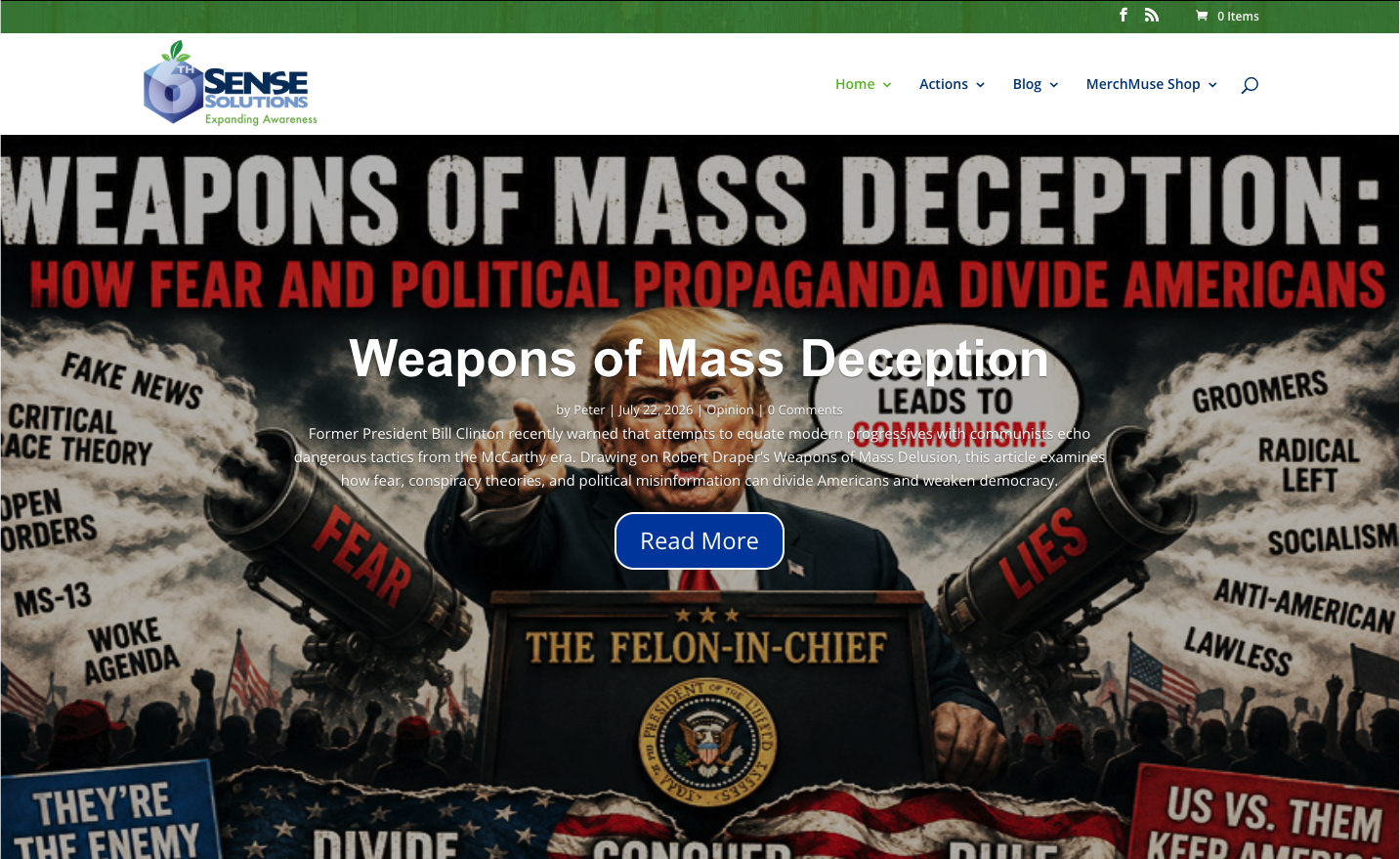

6th Sense Solutions was created to focus on community building, sharing creative ideas, our concerns and social awareness. Our mission is to provide truth to power and solutions for the betterment of society. We believe that everyone has an innate 6th sense – the ability to think beyond the ordinary, to be intuitively aware of their surroundings, and to use those insights to create something extraordinary. 6th Sense Solutions is passionate about making a positive impact on the world – we want to make a difference.
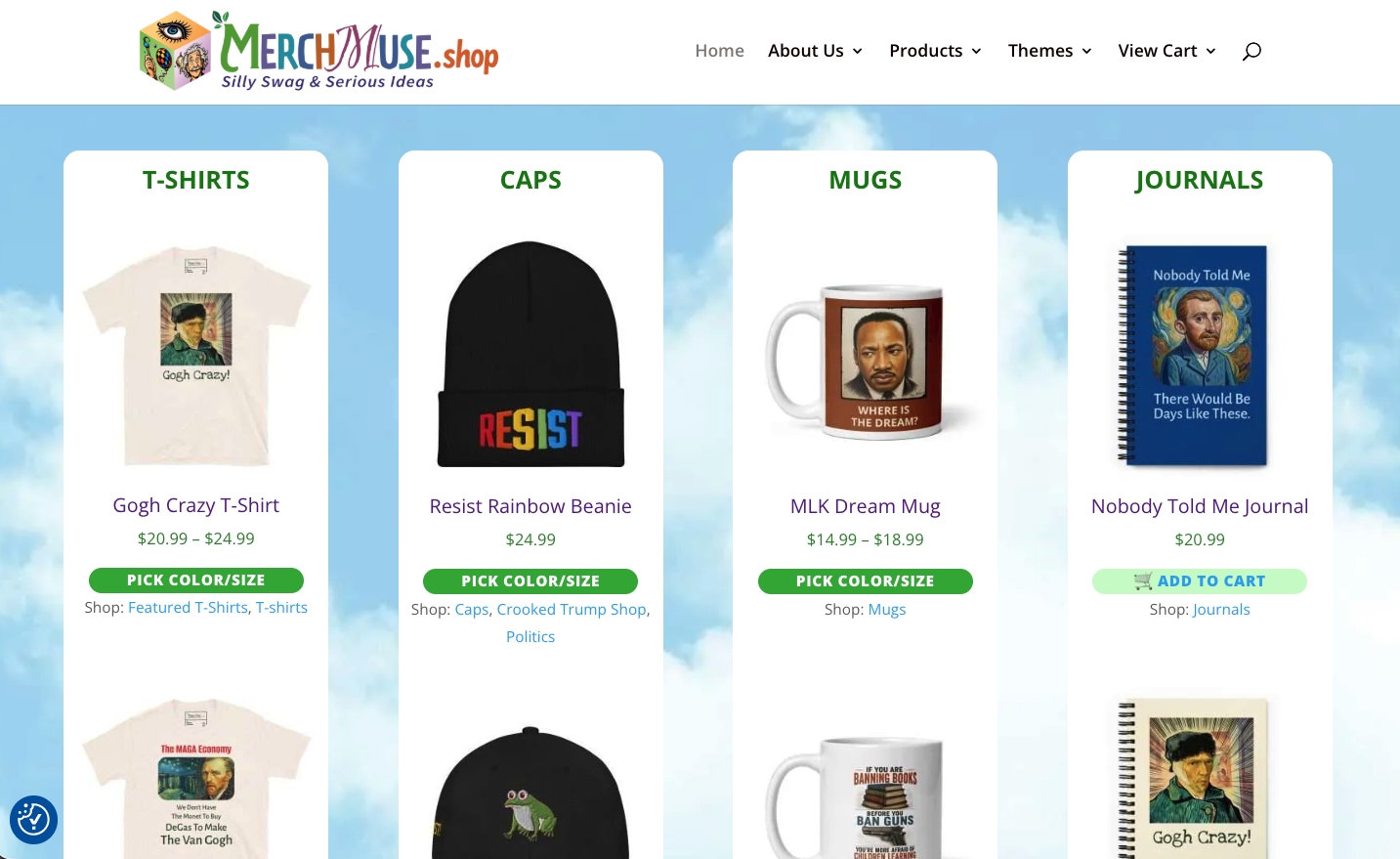
MerchMuse Shop, was created to be a destination for unique and artistic merchandise with silly designs and serious ideas for both fun and political awareness. Our goal is to become a thoughtful online destination for silly swag and mindful ideas that reflects a sense of identity, humor, activism, and style. At Merch Muse, we blend creativity with quality to offer a diverse range of products that are perfect for adding a touch of individuality to your everyday life or for finding that special gift.
Companies and Institutions I've had the pleasure of working with:














Please click on the logos above to see more information about each company or institution
Building Successful Visual Design
Great graphic design has always been about more than making something look good. It begins with understanding people—who they are, what they need, what motivates them, and what will make a message meaningful and memorable to them.
Today, graphic design is evolving rapidly. Artificial intelligence has become an increasingly powerful part of the creative process, offering new ways to explore ideas, generate visual possibilities, refine concepts, and work more efficiently. But AI does not replace the role of the designer. It is a tool, not the vision. The designer’s experience, creative judgment, strategic thinking, and understanding of the audience remain at the center of successful visual communication.
I combine decades of hands-on design experience with today's digital and AI-assisted tools to develop visual communications that are purposeful, engaging, persuasive, and built around the people they are intended to reach.
1 Start With the Audience: Every successful design begins with understanding the people on the other side of the communication. I consider the target audience's demographics, interests, expectations, behaviors, needs, and cultural context before deciding how a message should look and feel. AI can help analyze information, identify patterns, and explore possibilities, but understanding why people respond to an idea requires human insight. The technology can assist the process; the designer determines what matters.
2 Lead With Strategy and Purpose: Design should solve a communication problem, not simply decorate a page, screen, package, or product. Before developing a visual direction, I consider the purpose of the communication: What are we trying to say? Who needs to hear it? What should they understand, feel, or do after seeing it? A strong concept gives every design decision a reason—from typography and imagery to color, composition, hierarchy, and tone.
3 Use AI as a Creative Partner: AI has fundamentally expanded what designers can explore and accomplish. It can help generate concepts, investigate visual directions, create variations, accelerate production tasks, and open creative avenues that might otherwise take considerably more time to explore. But generating an image is not the same as developing an effective design. I use AI where it adds value while applying human creative direction, editing, refinement, and judgment. The goal isn't to produce something simply because AI can produce it. The goal is to use technology intelligently to create better communication and stronger creative solutions.
4 Make the Message Clear: Great visual design communicates before the audience has time to think about how it was created. Whether the project is a brand identity, website, publication, advertisement, package, presentation, or campaign, the central message should be immediately understandable. Typography, imagery, hierarchy, spacing, and composition should work together rather than compete with one another. Technology may provide more ways to create visual content than ever before. That makes clarity and creative editing even more important.
5 Create Visual Impact: People notice before they read. Effective design uses visual language to attract attention and create an emotional connection. Color, typography, photography, illustration, imagery, motion, scale, contrast, and composition all contribute to how a message is perceived. AI can provide an extraordinary range of visual possibilities, but choosing the right visual direction—and knowing when to simplify or reject an idea—is where experience matters. The objective isn't simply to create something beautiful. It is to create something relevant, distinctive, and memorable.
6 Build Consistency Across Every Touchpoint: A strong brand is more than a logo. It is a recognizable visual language that creates continuity wherever people encounter it. I develop design systems that maintain consistency across websites, social media, advertising, packaging, print, presentations, signage, and other communications. Color, typography, imagery, layout, and tone should work together to create a cohesive identity. AI can help extend a visual system into new formats and applications, but the underlying creative standards need to remain consistent and intentional.
7 Design for Usability and Accessibility: Good design should work for as many people as possible. Digital experiences need to be intuitive, readable, navigable, and accessible to people with different abilities and circumstances. This includes thoughtful typography, contrast, hierarchy, navigation, responsive design, alternative text, and other accessibility considerations. The most sophisticated technology in the world doesn't make a design successful if people can't understand or use it.
8 Question, Edit, and Refine: One of the most important roles of a designer has always been knowing what not to use. AI can generate hundreds of possibilities in the time it once took to develop a handful. That abundance can be valuable—but it can also create noise. More choices don't automatically produce better design. I believe the designer's role increasingly involves being an editor, curator, and creative director: evaluating possibilities, identifying what has potential, eliminating what doesn't, and refining the strongest ideas until they communicate with clarity and purpose.
9 Test, Listen, and Adapt: Design is not finished simply because the designer likes it. Whenever appropriate, I seek feedback and evaluate how effectively a design communicates with its intended audience. Testing, observation, analytics, client feedback, and real-world results can reveal opportunities to improve the work. Design should evolve when the audience, technology, marketplace, or communication goals evolve.
Satisfied Clients

“Peter’s work impressed me on multiple levels. He understood fully what I wanted to accomplish and made suggestions to improve upon my ideas. Peter created some beautiful designs for my consideration, and did it in a timely manner with excellent communication skills. Peter is a wonderfully talented creative person and I would hire him again to help me with any new designs.”

"I’ve worked with Peter for many years. He does top-notch design work, regularly coming out with fresh designs that completely fit the personality of his business clients. He’s talented at everything from developing a unique personality for a business to custom logos to fresh takes on individual icons. He experiments with many different approaches while working with his clients, generally in a fairly intensive process, and then comes out with pure genius. Highly recommended for any business looking to establish, extend, or refine their visual brand."

"I wanted to thank you for the great work you did on the graphics for the Enterprise Deployment Guide. Not only were they exactly what we needed, but we really enjoyed working with you during the process. Thank you for the excellent work!"
To Reach Me
Would love to hear what you think. If you are interested in working on a project, even better
+1 206.841.6248